Table of Contents

Beke-Somfai Lab: Biomolecular Self-Assembly

Founded in 08/2015, the group is focused on biologically relevant molecules and macromolecular complexes, where intermolecular interactions play a pivotal role in manifesting biological function. We are particularly interested in molecular level understanding of structure, function and mechanisms of membrane active compounds. Our aim is to study and design natural and nature-mimicking species which can be further developed in biomedical applications targeting organism-specific membranes.

Research Interests
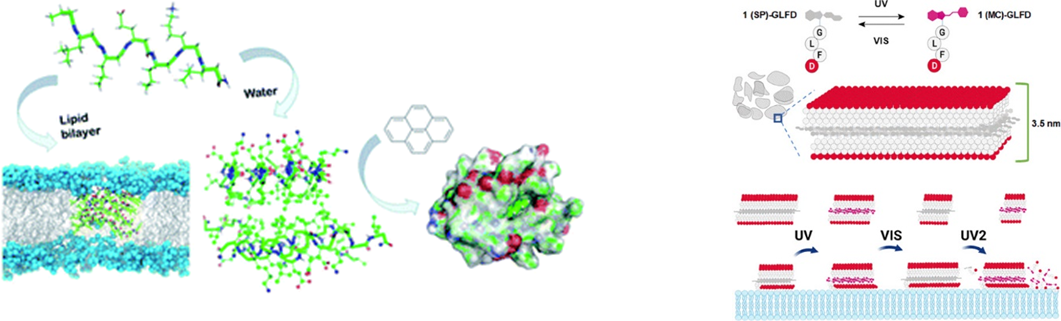
The group focuses its research activities on molecular level understanding of structure, function and mechanisms of membrane active compounds, primarily natural and non-natural peptides with antimicrobial potency.
Natural antimicrobial peptides or host defense peptides constitute a part of the innate immune system of the host organisms and help in the fight against invading pathogens. They have a broad-spectrum activity against various bacteria, and fungi, in addition, they also show antiviral and anticancer properties. Their mechanism of action **involves disruption of target cell membranes, moreover, they can elicit immunoregulatory actions as well. They represent a promising novel tool to combat multidrug-resistant bacteria, the emerging number of which represents a global threat. Beyond their **applicability in human health care, antimicrobial peptides have potential in various fields, e.g. as biopesticide components to protect cultured plants in agriculture, nutrient additives in livestock, food preservatives in food industry, or even in wastewater treatment.

Despite the many advantages of natural antimicrobial peptides over common antibiotics, their proteolytic sensitivity can limit their medical use. In this regard, peptidomimetic agents called foldamers with structural and folding properties comparable to their natural templates can represent a good alternative. Non-natural peptides display excellent self-organising properties ranging from toxic amyloid oligomers to ion channel formation, with tunable applications ranging from tissue engineering through antiviral and antibacterial therapeutics to supramolecular polymer tubes.

  1. Interplay between membrane active host defense peptides and heme modulates their assemblies and in vitro activity (2021)
    Tünde Juhász, Mayra Quemé-Peña, Bence Kővágó, Judith Mihály, Maria Ricci, Kata Horváti, Szilvia Bősze, Ferenc Zsila, Tamás Beke-Somfai Scientific Reports 11/1
    Springer Science and Business Media LLC DOI:10.1038/s41598-021-97779-2
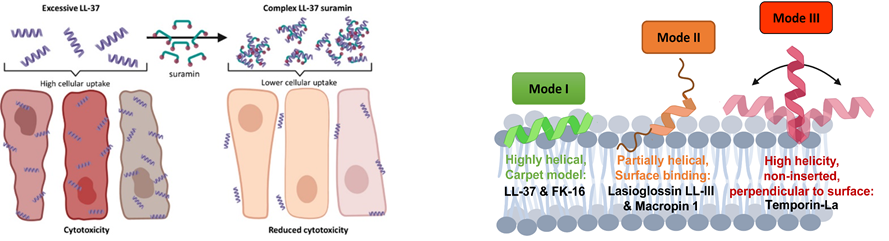
  2. Membrane Association Modes of Natural Anticancer Peptides: Mechanistic Details on Helicity, Orientation, and Surface Coverage (2021)
    Mayra Quemé-Peña, Tünde Juhász, Gergely Kohut, Maria Ricci, Priyanka Singh, Imola Cs. Szigyártó, Zita I. Papp, Lívia Fülöp, Tamás Beke-Somfai International Journal of Molecular Sciences 22/16 p8613
    MDPI AG DOI:10.3390/ijms22168613
  3. Quorum Sensing Pseudomonas Quinolone Signal Forms Chiral Supramolecular Assemblies With the Host Defense Peptide LL-37 (2021)
    Ferenc Zsila, Maria Ricci, Imola Csilla Szigyártó, Priyanka Singh, Tamás Beke-Somfai Frontiers in Molecular Biosciences 8
    Frontiers Media SA DOI:10.3389/fmolb.2021.742023
  4. Anionic food color tartrazine enhances antibacterial efficacy of histatin-derived peptide DHVAR4 by fine-tuning its membrane activity (2020)
    Maria Ricci, Kata Horváti, Tünde Juhász, Imola Szigyártó, György Török, Fanni Sebák, Andrea Bodor, László Homolya, Judit Henczkó, Bernadett Pályi, Tamás Mlinkó, Judith Mihály, Bilal Nizami, Zihuayuan Yang, Fengming Lin, Xiaolin Lu, Loránd Románszki, Attila Bóta, Zoltán Varga, Szilvia Bősze, Ferenc Zsila, Tamás Beke-Somfai Quarterly Reviews of Biophysics 53
    Cambridge University Press (CUP) DOI:10.1017/s0033583520000013
  5. Membrane active Janus-oligomers of β<sup>3</sup>-peptides (2020)
    Imola Cs. Szigyártó, Judith Mihály, András Wacha, Dóra Bogdán, Tünde Juhász, Gergely Kohut, Gitta Schlosser, Ferenc Zsila, Vlada Urlacher, Zoltán Varga, Ferenc Fülöp, Attila Bóta, István Mándity, Tamás Beke-Somfai Chemical Science 11/26 p6868-6881
    Royal Society of Chemistry (RSC) DOI:10.1039/d0sc01344g
  6. Stimuli-Responsive Membrane Anchor Peptide Nanofoils for Tunable Membrane Association and Lipid Bilayer Fusion (2022)
    Vignesh Udyavara Nagaraj, Tünde Juhász, Mayra Quemé-Peña, Imola Cs. Szigyártó, Dóra Bogdán, András Wacha, Judith Mihály, Loránd Románszki, Zoltán Varga, Joakim Andréasson, István Mándity, Tamás Beke-Somfai ACS Applied Materials &amp; Interfaces 14/50 p55320-55331
    American Chemical Society (ACS) DOI:10.1021/acsami.2c11946
We also focus on standardized isolation and characterization protocol development for extracellular vesicles and on the molecular engineering of these species.
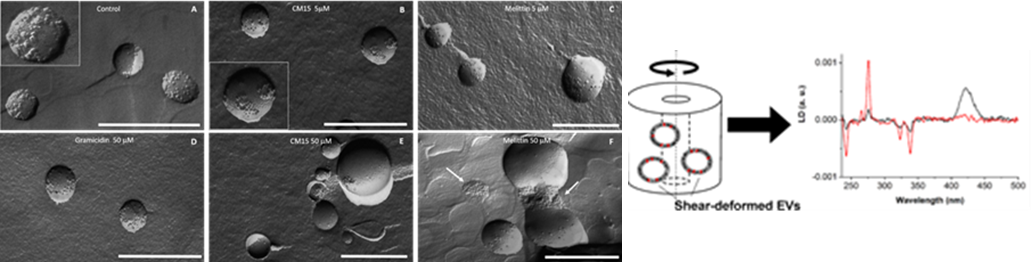
Extracellular vesicles (EVs) are biological nanoparticles, surrounded by a phospholipid bilayer and released by various cells into the extracellular space. They are classified based on their cellular origin, biogenesis and physicochemical properties. They can carry different type of biomolecules (such as DNA, RNA, proteins, phospholipids) which are characteristic to the particular cells producing them. Besides membrane inserted proteins, in vivo systems can also contain biomolecules adsorbed on their surface, known as protein corona. Evs are important mediators of intracellular communication and are involved in many physiological and pathological processes, so they may provide a wealth of information for early diagnosis and treatment of various diseases. Beyond these roles, they can be used as potential delivery vehicles for different drugs, food nutrient, inorganic nanoparticles etc. Therefore, the composition, modulation and characterization of protein corona is essential, as can influence their bioavailability, bio-distribution and their applicability.
  1. Flow Alignment of Extracellular Vesicles: Structure and Orientation of Membrane‐Associated Bio‐macromolecules Studied with Polarized Light (2018)
    Imola Cs. Szigyártó, Róbert Deák, Judith Mihály, Sandra Rocha, Ferenc Zsila, Zoltán Varga, Tamás Beke‐Somfai ChemBioChem 19/6 p545-551
    Wiley DOI:10.1002/cbic.201700378
  2. Membrane Active Peptides Remove Surface Adsorbed Protein Corona From Extracellular Vesicles of Red Blood Cells (2020)
    Priyanka Singh, Imola Cs. Szigyártó, Maria Ricci, Ferenc Zsila, Tünde Juhász, Judith Mihály, Szilvia Bősze, Éva Bulyáki, József Kardos, Diána Kitka, Zoltán Varga, Tamás Beke-Somfai Frontiers in Chemistry 8
    Frontiers Media SA DOI:10.3389/fchem.2020.00703
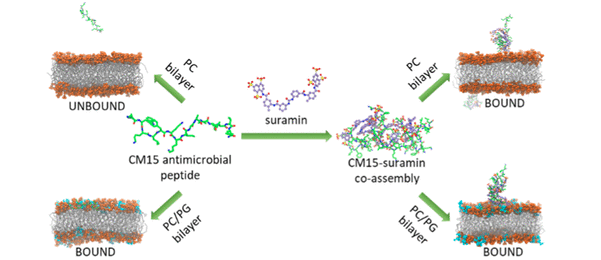
Besides experimental investigations, we employ all-atom Molecular Dynamics (MD), Coarse-Grained MD as well as quantum chemical simulations with numerous antimicrobial peptides (AMP) in order to investigate their behaviour and binding conformations on complex membranes, extracellular vesicles (EVs), and single composition lipid bilayers. We are particularly interested in studiyng peptide interactions with small molecules (eg. with drug molecules, food colors, bacterial and human signalling compounds, etc.). Here it is crucial to understand how how these interactions can cause structural changes in AMPs as well as affect their membrane binding properties. Our studies are often supplemented with molecular Docking tools that helps identifying initial docking sites of the molecules on larger species and assists model building when experimental structural details are lacking. Furthermore simulations enable calculation of electrostatic potentials, entropy, binding free energy and other quantifiable parameters, which greatly helps for objective comparison of different systems. Lastly quantum chemical calculations are also frequently used in order to parametrize molecules for MD simulations and also to assess their photophysical and conformational properties.
  1. Controlling Peptide Function by Directed Assembly Formation: Mechanistic Insights Using Multiscale Modeling on an Antimicrobial Peptide–Drug–Membrane System (2021)
    Gergely Kohut, Tünde Juhász, Mayra Quemé-Peña, Szilvia Erika Bősze, Tamás Beke-Somfai ACS Omega 6/24 p15756-15769
    American Chemical Society (ACS) DOI:10.1021/acsomega.1c01114
  2. Membrane Association Modes of Natural Anticancer Peptides: Mechanistic Details on Helicity, Orientation, and Surface Coverage (2021)
    Mayra Quemé-Peña, Tünde Juhász, Gergely Kohut, Maria Ricci, Priyanka Singh, Imola Cs. Szigyártó, Zita I. Papp, Lívia Fülöp, Tamás Beke-Somfai International Journal of Molecular Sciences 22/16 p8613
    MDPI AG DOI:10.3390/ijms22168613
  3. Membrane active Janus-oligomers of β<sup>3</sup>-peptides (2020)
    Imola Cs. Szigyártó, Judith Mihály, András Wacha, Dóra Bogdán, Tünde Juhász, Gergely Kohut, Gitta Schlosser, Ferenc Zsila, Vlada Urlacher, Zoltán Varga, Ferenc Fülöp, Attila Bóta, István Mándity, Tamás Beke-Somfai Chemical Science 11/26 p6868-6881
    Royal Society of Chemistry (RSC) DOI:10.1039/d0sc01344g
  4. Analysis of Procollagen C-Proteinase Enhancer-1/Glycosaminoglycan Binding Sites and of the Potential Role of Calcium Ions in the Interaction (2019)
    Jan Potthoff, Krzysztof K. Bojarski, Gergely Kohut, Agnieszka G. Lipska, Adam Liwo, Efrat Kessler, Sylvie Ricard-Blum, Sergey A. Samsonov International Journal of Molecular Sciences 20/20 p5021
    MDPI AG DOI:10.3390/ijms20205021
  5. Disorder-to-helix conformational conversion of the human immunomodulatory peptide LL-37 induced by antiinflammatory drugs, food dyes and some metabolites (2019)
    Ferenc Zsila, Gergely Kohut, Tamás Beke-Somfai International Journal of Biological Macromolecules 129 p50-60
    Elsevier BV DOI:10.1016/j.ijbiomac.2019.01.209
  6. The molecular mechanism of structural changes in the antimicrobial peptide CM15 upon complex formation with drug molecule suramin: a computational analysis (2019)
    Gergely Kohut, Adam Sieradzan, Ferenc Zsila, Tünde Juhász, Szilvia Bősze, Adam Liwo, Sergey A. Samsonov, Tamás Beke-Somfai Physical Chemistry Chemical Physics 21/20 p10644-10659
    Royal Society of Chemistry (RSC) DOI:10.1039/c9cp00471h
  7. Protein–Ligand Interaction Energy-Based Entropy Calculations: Fundamental Challenges For Flexible Systems (2018)
    Gergely Kohut, Adam Liwo, Szilvia Bősze, Tamás Beke-Somfai, Sergey A. Samsonov The Journal of Physical Chemistry B 122/32 p7821-7827
    American Chemical Society (ACS) DOI:10.1021/acs.jpcb.8b03658

Expertise

Members

beke_somfai_tamas.jpg Tamás Beke-Somfai Group leader
juhasz_tunde.jpg Tünde Juhász Senior researcher
szigyarto_imola.jpg Imola Csilla Szigyártó Senior researcher
Natália Tőkési Senior researcher
omaima_barkaoui.jpg Omaima Barkaoui PhD student
fiza_faiz.jpg Fiza Faiz PhD student
zineb_medjeldi.jpg Zineb Medjeldi PhD student
pavela_oliver.jpg Olivér Pavela PhD student
Klinsalee Rachaneekorn PhD student
tasvilla_sonallya.jpg Tasvilla Sonallya PhD student
ludwe_saliwa.jpeg Ludwe Saliwa Undergraduate student
Katja Vasmatics Undergraduate student
gradne_szabo_rita.jpg Rita Grádné Szabó Assistant
Sohini Chakraborty Alumni
Gergő Gyarmathy Alumni
Tamás Keszthelyi Alumni
Gergely Kohut Alumni
Benjámin Kovács Alumni
Bence Kővágó Alumni
Bilal Nizami Alumni
Mayra Quemé Peña Alumni
Maria Ricci Alumni
Priyanka Singh Alumni
Vignesh Udyavara Nagaraj Alumni
Kamilla Ujvári Alumni
Ferenc Zsila Alumni
Kamal el Battioui Alumni